Decoding Ancient India: Understanding the 4 Vedas and 18 Puranas

Have you ever wondered about the profound wisdom that shaped one of the world's oldest civilizations? Imagine a time when knowledge was not just written, but chanted, revered, and passed down through generations, forming the very bedrock of a culture. This wisdom, encapsulated in the 4 Vedas and 18 Puranas, represents the heart of Ancient Indian Scriptures, offering a timeless guide to life, spirituality, and the cosmos.
For spiritual seekers, history enthusiasts, students, and practitioners of yoga or astrology, delving into these foundational Hindu Texts is like unlocking a treasure chest of ancient insights. At Jyotish Dev, we believe in bridging ancient cosmic wisdom with modern life needs, and understanding these scriptures is a crucial step in that journey of self-discovery.
These sacred texts, often referred to as Vedic Literature, are far more than mere historical documents; they are living philosophies that continue to influence millions worldwide in 2026. This comprehensive guide will embark on a journey to decode the 4 Vedas and 18 Puranas explained, offering clarity on their purpose, structure, and enduring significance. We'll explore the Vedas and Puranas difference, providing an accessible pathway for anyone eager to understand the depth of these spiritual traditions.
Key Takeaways:
The 4 Vedas are the oldest and most authoritative Hindu texts, primarily focusing on rituals, hymns, and philosophical insights.
The 18 Puranas are later compositions, serving to popularize Vedic teachings through captivating myths, legends, and genealogies.
While the Vedas are considered Shruti (revealed knowledge), the Puranas are Smriti (remembered or traditional knowledge), offering different yet complementary perspectives.
Understanding these ancient Indian Scriptures provides a deep appreciation for the philosophical, cultural, and spiritual heritage of India.
Both the Vedas and Puranas offer invaluable guidance for personal growth, ethical living, and navigating the complexities of existence, resonating deeply with the principles of Vedic Astrology.
The Pillars of Wisdom: Exploring the 4 Vedas Explained
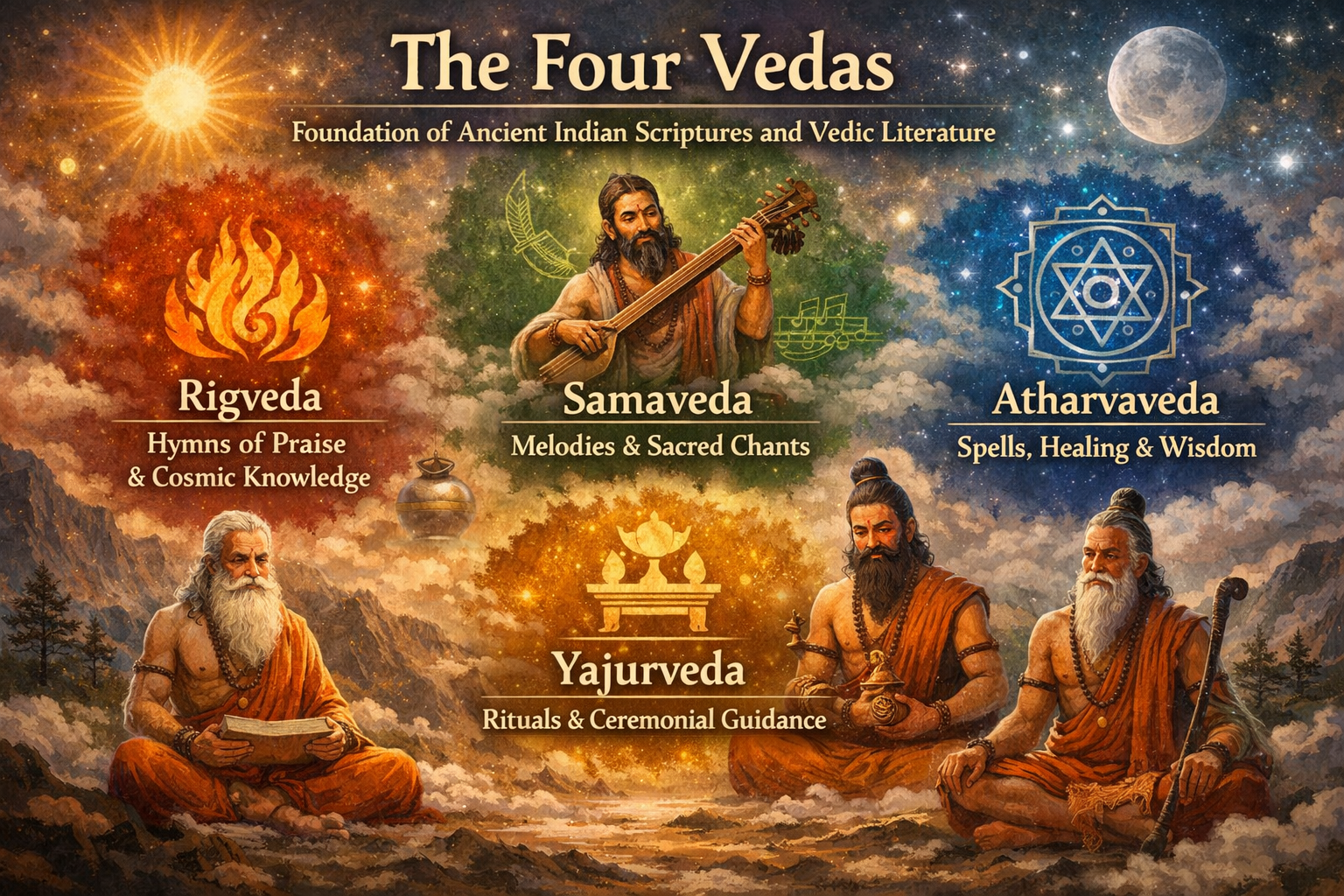
The Vedas, meaning "knowledge" or "wisdom" in Sanskrit, are the oldest and most revered scriptures of Hinduism. They are considered Shruti—that which is heard or revealed—believed to have been revealed to ancient sages (Rishis) during deep meditative states. Composed over several centuries, dating back possibly to 1500-1200 BCE, the 4 Vedas form the very foundation of Vedic Literature, influencing philosophy, ritual, and societal structure for millennia.
To truly grasp the essence of Ancient Indian Scriptures, one must first understand the unique contribution of each Veda. They are not merely books; they are vast compilations of hymns, prayers, philosophical treatises, and ritual instructions, each serving a distinct purpose in the grand tapestry of spiritual wisdom.
Rigveda: The Veda of Hymns and Praise 🙏
The Rigveda is arguably the most ancient and foundational of the 4 Vedas. It is a collection of 1,028 hymns (suktas) organized into ten books (mandalas), primarily dedicated to praising various deities of the Vedic pantheon. These hymns invoke gods like Agni (fire), Indra (thunder and war), Surya (sun), Vayu (wind), and many others, seeking their blessings for prosperity, health, and protection.
Structure and Content: The Rigveda is rich in poetic verse, depicting cosmic phenomena, daily life, and profound philosophical questions about creation and existence. It contains the famous Purusha Sukta, which describes the cosmic man from whom the universe was created, and the Nāsadīya Sūkta (Hymn of Creation), which famously questions the origins of the cosmos, hinting at a reality beyond human comprehension.
Significance: The Rigveda provides unparalleled insights into the early Vedic worldview, cosmology, and the spiritual aspirations of ancient peoples. Its language, Vedic Sanskrit, is one of the oldest attested Indo-European languages, making it a crucial text for linguistic and historical studies. For those interested in the origins of spiritual thought, the Rigveda is an indispensable source.
Sama-Veda: The Veda of Chants and Melodies 🎶
Derived largely from the Rigveda, the Samaveda is less about new hymns and more about musical arrangements of existing ones. Its name comes from 'Saman,' meaning a melody or a chant. The Samaveda is essentially a "textbook" for the udgatar priests, who were responsible for chanting these melodic hymns during sacrifices.
Structure and Content: It contains 1,875 verses, with most of them borrowed from the Rigveda, specifically from the eighth and ninth mandalas. The innovation lies in the musical notation and the intricate rules for chanting, which transformed the simple Rigvedic verses into powerful, resonant melodies intended to enhance the efficacy of rituals.
Significance: The Samaveda is considered the root of Indian classical music and dance. Its emphasis on sound and vibration as a spiritual tool highlights a core aspect of Vedic practice—that sound (nada) holds immense power. For practitioners of mantra yoga or those interested in the spiritual power of sound, the Samaveda offers profound insights into how specific intonations can connect us to the cosmic influence.
Yajurveda: The Veda of Sacrificial Formulas 🕊️
The Yajurveda, or "Veda of Sacrificial Formulas," focuses on the prose mantras and specific rituals to be performed during Vedic sacrifices (yajnas). It serves as a practical handbook for the adhvaryu priests, who carried out the physical actions of the sacrifice.
Structure and Content: The Yajurveda is unique in that it exists in two primary recensions: the Krishna (Black) Yajurveda and the Shukla (White) Yajurveda.
Krishna Yajurveda intersperses the mantras with explanatory prose and commentaries.
Shukla Yajurveda separates the hymns (Samhita) from the prose explanations (Brahmana).
Both contain detailed instructions for performing various yajnas, from daily offerings to elaborate ceremonies meant for kings and large communities.
Significance: The Yajurveda provides a clear window into the ritualistic core of ancient Vedic religion. It details the precise actions, offerings, and invocations necessary to maintain cosmic order (Rta) and achieve desired outcomes. While modern practices may differ, the underlying principles of disciplined action and focused intention found in the Yajurveda continue to resonate. It emphasizes the importance of precise execution and intention in all endeavors, a principle we see echoed in the meticulous calculations of Vedic Astrology.
Atharva-Veda: The Veda of Magical Formulas and Charms ✨
The Atharva-Veda stands apart from the other three Vedas, often considered the "fourth Veda" added later to the canon. It is a collection of hymns, spells, and incantations dealing with more pragmatic, everyday concerns of life.
Structure and Content: It contains about 730 hymns, divided into 20 books, covering a wide range of topics: healing from diseases, protection from evil spirits, success in love, prosperity, statecraft, and philosophical speculations. While it also contains cosmogonic hymns, its focus is largely on worldly well-being and averting misfortune.
Significance: The Atharva-Veda offers a fascinating glimpse into the folk religion, popular beliefs, and practices of Ancient India. It demonstrates a broader scope of Vedic thought, encompassing both high philosophy and practical remedies for daily life. Its medical hymns are particularly noteworthy, laying some early foundations for Ayurvedic medicine. It highlights the human desire to navigate life's challenges and unlock potential through various means, including spiritual practices, a sentiment central to Jyotish Dev's mission.
The Vedas are the breath of the Supreme Being, revealed for the welfare of humanity.
The Grand Narratives: Understanding the 18 Puranas
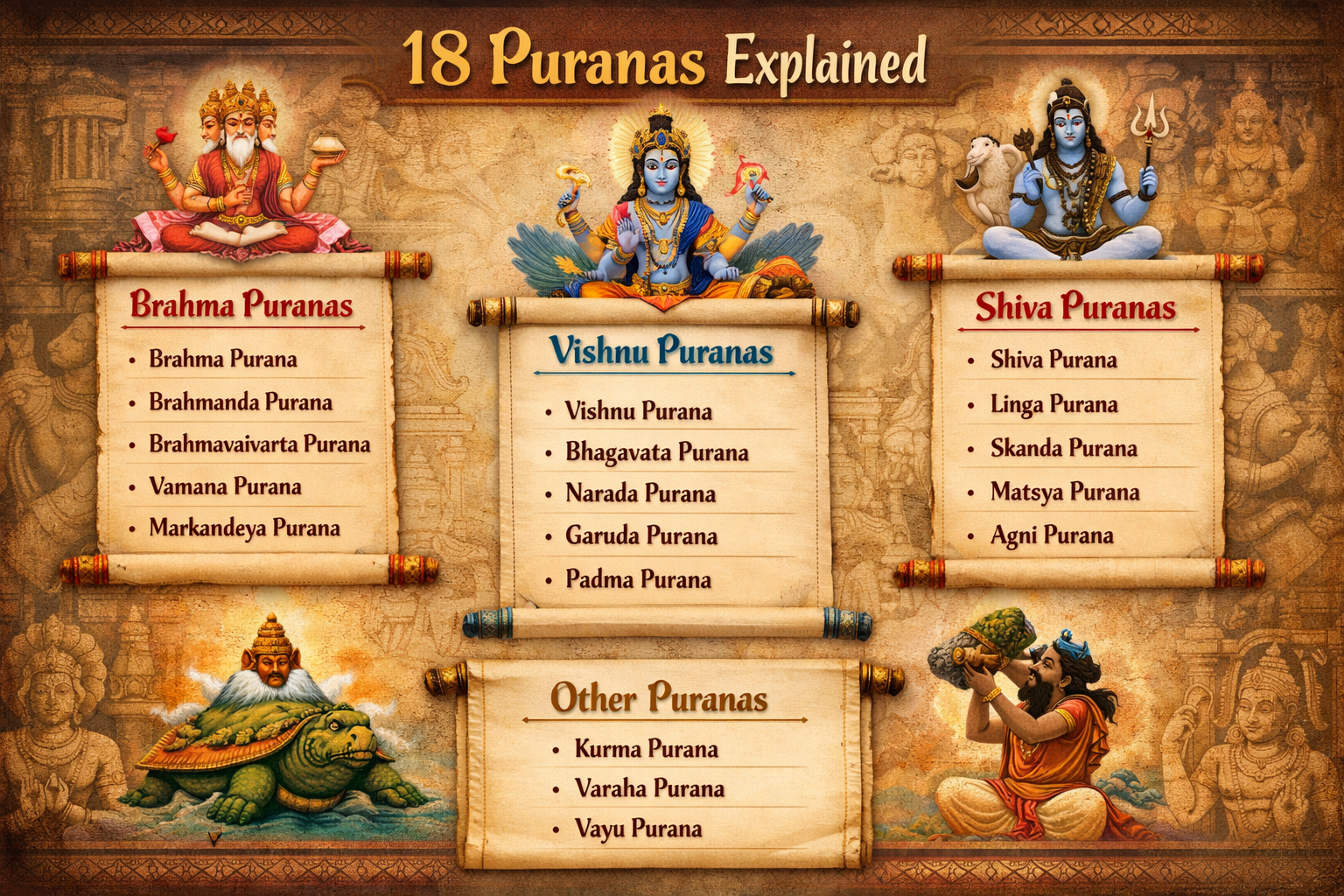
If the Vedas are the foundational legal codes and constitutional principles, the Puranas are the rich tapestry of stories, myths, and legends that bring these principles to life for the common person. The word "Purana" literally means "ancient" or "old narrative." These are part of Smriti literature—that which is remembered—and were composed much later than the Vedas, primarily between 300 CE and 1000 CE. The 18 Puranas serve as popular encyclopedias of Hindu culture, explaining complex Vedic concepts through engaging narratives.
They aim to make spiritual knowledge accessible, guiding individuals through stories of gods, goddesses, kings, sages, and cosmic cycles. These Ancient Indian Scriptures are vital for understanding the evolution of Hinduism and its diverse traditions. They bridge the gap between abstract Vedic philosophy and the devotional practices of the masses.
Vedas and Puranas Difference: A Clarification 🧐
While both the 4 Vedas and 18 Puranas are foundational Hindu Texts, understanding their key differences is crucial:
Feature | The 4 Vedas (Shruti) | The 18 Puranas (Smriti) |
|---|---|---|
Origin | Revealed (divine revelation to Rishis) | Remembered (composed by sages based on tradition) |
Nature | Primordial, eternal, unchangeable, authoritative | Traditional, interpretative, adaptable |
Focus | Rituals (Yajnas), hymns, abstract philosophy | Mythology, legends, genealogies, devotional stories |
Language | Archaic Vedic Sanskrit | Classical Sanskrit (more accessible) |
Purpose | Preserve cosmic truths, guide sacerdotal duties | Popularize Vedic teachings, inspire devotion, ethical guidance |
Audience | Priestly class (Brahmins) initially | General populace, including women and Sudras |
Key Concepts | Karma, Dharma, Brahman, Atman, Rta | Bhakti (devotion), avatar theory, creation stories |
People often compare the Vedas to the root and trunk of a tree, providing the essential structure, while the Puranas are the branches, leaves, and fruits, that make the tree accessible and nourishing to all.
They are complementary; the Puranas rely on the authority of the Vedas, while the Vedas gain broader understanding through the narratives of the Puranas. This distinction is vital for anyone trying to understand the full scope of Ancient Indian Scriptures guide.
The 18 Maha Puranas List: A Pantheon of Stories and Wisdom
The deity they predominantly glorify: Brahma, Vishnu, or Shiva traditionally groups the 18 Maha Puranas list. However, each Purana covers a vast array of topics, including cosmology, genealogies of gods and sages, descriptions of time cycles (yugas), rituals, ethical codes, and descriptions of holy places. They are dynamic texts, constantly retelling and reinterpreting stories, making them incredibly rich sources for understanding Hindu traditions.
Let’s explore the prominent Puranas within this extensive collection:
Brahma Puranas (Glorifying Brahma)
Brahma Purana: Often called the Adi Purana (first Purana), it describes the creation of the universe, the life of Brahma, and genealogies of kings. It also contains descriptions of pilgrimage sites and the glory of the sun god.
Brahmanda Purana: Focuses on the cosmic egg (Brahmanda), creation, future prophecies, and the geography of the earth. It famously contains the Adhyatma Ramayana, a philosophical retelling of the Rama story.
Brahma Vaivarta Purana: Primarily dedicated to Krishna and Radha, detailing their divine lilas (pastimes). It emphasizes the bhakti (devotional) path and the greatness of the divine couple.
Markandeya Purana: Named after the sage Markandeya, this Purana contains dialogues between sages and various narratives, including the revered Devi Mahatmyam (Chandi Path), which glorifies the Divine Mother.
Vishnu Puranas (Glorifying Vishnu)
Vishnu Purana: One of the most important and widely studied Puranas, it is systematically structured and covers cosmology, creation, destruction, genealogies, and the stories of various avatars of Vishnu, especially Krishna. It presents a comprehensive worldview.
Bhagavata Purana (Srimad Bhagavatam): Considered by many to be the most important of all Puranas, it primarily focuses on the life and teachings of Krishna, emphasizing the path of bhakti yoga or loving devotion. It has deeply influenced Vaishnavism and devotional movements across India. For those exploring spiritual paths like bhakti yoga, this text is indispensable [^1].
Narada Purana: Deals with the glories of Vishnu, religious duties, fasting, and pilgrimage. It also provides insights into astrological principles, making it particularly relevant for those interested in the wisdom of the stars.
Garuda Purana: Known for its descriptions of the afterlife, funeral rites, and karmic consequences. It also includes sections on ethics, medicine, and omens.
Padma Purana: A vast Purana containing stories about Vishnu, Lakshmi, Ganga, and various sacred places. It also includes legends, moral tales, and discussions on dharma.
Varaha Purana: Recounts the story of Vishnu's Varaha (boar) avatar and focuses on dharma, sacred places, and rituals.
Matsya Purana: Describes the Matsya (fish) avatar of Vishnu, the great deluge, and also contains detailed accounts of various deities, rituals, and pilgrimage sites.
Kurma Purana: Named after the Kurma (tortoise) avatar, it describes creation, the universe, and various dharma codes.
Vamana Purana: Centers around the Vamana (dwarf) avatar and other Vishnu legends, along with descriptions of holy places.
Shiva Puranas (Glorifying Shiva)
Shiva Purana: Dedicated to the glory of Lord Shiva, it describes his various forms, divine pastimes, his consort Parvati, and the significance of his worship through Linga and various rituals.
Linga Purana: Focuses on the origin and significance of the Lingam (Shiva's aniconic representation) and the importance of its worship. It also details the creation of the universe and Shiva's various manifestations.
Skanda Purana: The largest of all Puranas, it is dedicated to Kartikeya (Skanda), the son of Shiva. It contains numerous pilgrimage guides to sacred sites and temples across India, along with myths and legends associated with these places.
Agni Purana: A vast encyclopedia covering a wide range of subjects including warfare, archery, politics, medicine, poetry, grammar, astrology, and descriptions of various deities. It offers a unique window into the secular knowledge preserved within sacred texts.
Bhavishya Purana: Meaning "Purana of the Future," it contains prophecies about future events, kings, and historical figures, as well as descriptions of rituals and festivals.
The Puranas transform complex Vedic truths into stories that resonate with the heart, making wisdom accessible to all.
The Enduring Relevance of Ancient Indian Scriptures in 2026

In an age of rapid technological advancement and constant change, why should we turn to Ancient Indian Scriptures like the 4 Vedas and 18 Puranas? The answer lies in their timeless wisdom and their capacity to provide profound guidance for navigating our modern lives.
At Jyotish Dev, our purpose is to help individuals unlock their potential and navigate their path through the wisdom of the stars, and these texts build much of that cosmic understanding.
Philosophical Depth and Ethical Guidance
The Vedas introduce fundamental concepts like Dharma (righteous conduct), Karma (action and its consequences), and the interconnectedness of all existence. These philosophical underpinnings are not mere academic theories; they are practical frameworks for ethical living. For instance, understanding dharma can help us make informed decisions in our careers and relationships [^2]. The Puranas, through their captivating narratives, illustrate these complex principles in action, showing the triumphs and tribulations of characters who embody or deviate from dharma.
Consider the story of Prahlada in the Bhagavata Purana, who unwavering devotion to Vishnu even in the face of immense persecution from his own father, Hiranyakashipu, showcases the power of faith and righteousness. These stories offer moral lessons that transcend time, encouraging virtues like truthfulness, compassion, and perseverance.
Cultural and Spiritual Heritage
The 4 Vedas and 18 Puranas are not just religious texts; they are encyclopedias of Ancient Indian culture. They provide detailed accounts of social structures, customs, festivals, arts, and sciences. From the origins of sacred music in the Samaveda to the architectural descriptions found in some Puranas, these texts are invaluable for understanding the rich tapestry of Indian civilization.
For many, these scriptures are a source of spiritual comfort and inspiration. They provide a narrative of the divine, offering different pathways to connect with the ultimate reality, whether through ritual, devotion, or philosophical inquiry. They embody a living tradition that continues to shape rituals, festivals, and personal spiritual practices in 2026.
Connection to Vedic Astrology and Self-Discovery
Vedic Astrology, or Jyotish, deeply roots in Vedic philosophy and cosmology. The Vedas and Puranas connect the understanding of planetary influences, cosmic cycles, and the concept of karma intrinsically to their teachings. The Puranas, in particular often narrate the stories of various deities associated with planets, providing a mythological context to astrological interpretations. For example, the stories of Shiva's power and austerity resonate with the influence of Saturn (Shani) in a Kundali [^3].
At Jyotish Dev, we use these ancient principles to offer personalized readings and Kundali insights that help individuals understand their unique cosmic blueprint. Just as the Puranas helped ancient seekers discover the mysteries of the cosmos through stories, Vedic Astrology helps modern seekers understand their life's journey through the wisdom of the stars.
By understanding the deeper philosophical context of the Vedas and Puranas, one can gain a much richer appreciation for the insights provided by a Vedic Astrology consultation. It's about more than just predictions; it's about self-discovery and harnessing cosmic influence to guide your journey.
Navigating the Text: An Ancient Indian Scriptures Guide

Approaching these vast collections of Hindu Texts can seem daunting, especially for beginners. However, with a systematic approach, anyone can begin to unravel their profound wisdom.
Start with Summaries and Introductions: Before diving into the original Sanskrit texts, begin with accessible translations and scholarly summaries that provide context and explain key concepts. Many excellent resources are available online and in print.
Focus on the Philosophy, Not Just the Rituals: While the Vedas contain detailed rituals, focus first on the underlying philosophical principles. What do these texts say about reality, the self, and our place in the cosmos?
Read the Puranas for Storytelling: The Puranas are best approached as epic narratives. Allow yourself to be drawn into the stories of gods and heroes. These tales are engaging and instructive. The Bhagavata Purana is an excellent starting point for its devotional focus.
Connect to Personal Practice: Reflect on how these ancient teachings relate to your own life and spiritual journey. Whether it's through meditation, ethical reflection, or understanding your birth chart, try to find practical applications. For instance, the emphasis on righteous action (dharma) can be integrated into daily decision-making.
Utilize Modern Resources: Platforms like Jyotish Dev offer modern tools and expert guidance to help you connect with ancient wisdom. While we don't translate Vedas directly, their principles deeply informed our astrological insights. Learning about planetary effects or understanding your Kundali can be a complementary way to engage with the broader Ancient Indian Scriptures guide.
Remember, the journey of understanding these texts is a continuous one. It's about absorbing timeless knowledge that helps us unlock our potential and navigate our path with greater clarity and purpose in 2026 and beyond.
Conclusion: The Ever-Flowing River of Vedic Knowledge
The 4 Vedas and 18 Puranas stand as monumental testaments to the intellectual, spiritual, and cultural richness of Ancient India. From the profound hymns of the Rigveda that ponder the origins of existence to the vivid narratives of the Puranas that bring divine stories to life, these Ancient Indian Scriptures offer an unparalleled repository of human wisdom.
They provide a continuous source of inspiration and guidance for spiritual seekers, history enthusiasts, students, and anyone curious about the foundational Hindu Texts.
Understanding the Vedas and Puranas difference reveals a brilliant strategy for knowledge transmission: the Vedas as the bedrock of revealed truth, and the Puranas as the engaging, accessible elaborations for the masses. Together, they form a comprehensive Vedic Literature that continues to influence thought, ethics, and spirituality globally in 2026.
Actionable Next Steps:
Explore Further: Pick one Purana (e.g., Bhagavata Purana or Vishnu Purana) and find an accessible translation to begin reading its stories.
Connect with Jyotish Dev: Dive deeper into how this ancient wisdom applies to your personal life. Consider exploring our resources on Vedic Astrology and its importance or even getting a personalized Kundali reading to understand your unique cosmic blueprint.
Reflect on Dharma: Think about how the concepts of Dharma and Karma from these scriptures can inform your daily decisions and guide you toward a more purposeful life.
Listen to Chants: Experience the power of sound by listening to Vedic chants or devotional kirtans, connecting with the essence of the Samaveda and the devotional spirit of the Puranas.
Embrace the journey of wisdom; the Ancient Indian Scriptures await your exploration.
References
[^1]: Bhagavata Purana. (n.d.). Various translations are available.
[^2]: Mahabharata. (n.d.). Various translations are available.
[^3]: Brihat Parashara Hora Shastra. (n.d.). Various translations are available.